The color matching game that actually trains your eye
Most color games ask you to sort tiles. Hueful asks you to do something harder and more satisfying: look at a color, then mix it yourself, by eye.
A color matching game shows you a target color and challenges you to reproduce or identify it. Hueful gives you one new color every day and three rounds to mix it with RGB and HSL sliders. Your score is based on perceptual color distance (ΔE), so it measures how close your match looks, not how close the numbers are.
What is a color matching game?
A color matching game tests how precisely you see color. Instead of arranging tiles into a gradient or tapping the odd one out, a true matching game hands you the controls: here is the target, now recreate it. That small difference changes everything. Sorting relies on comparison, but mixing relies on your internal sense of what red, green, and blue are doing inside a color. That sense is trainable, and it is the skill painters, designers, and photographers lean on every day.
How Hueful's three rounds work
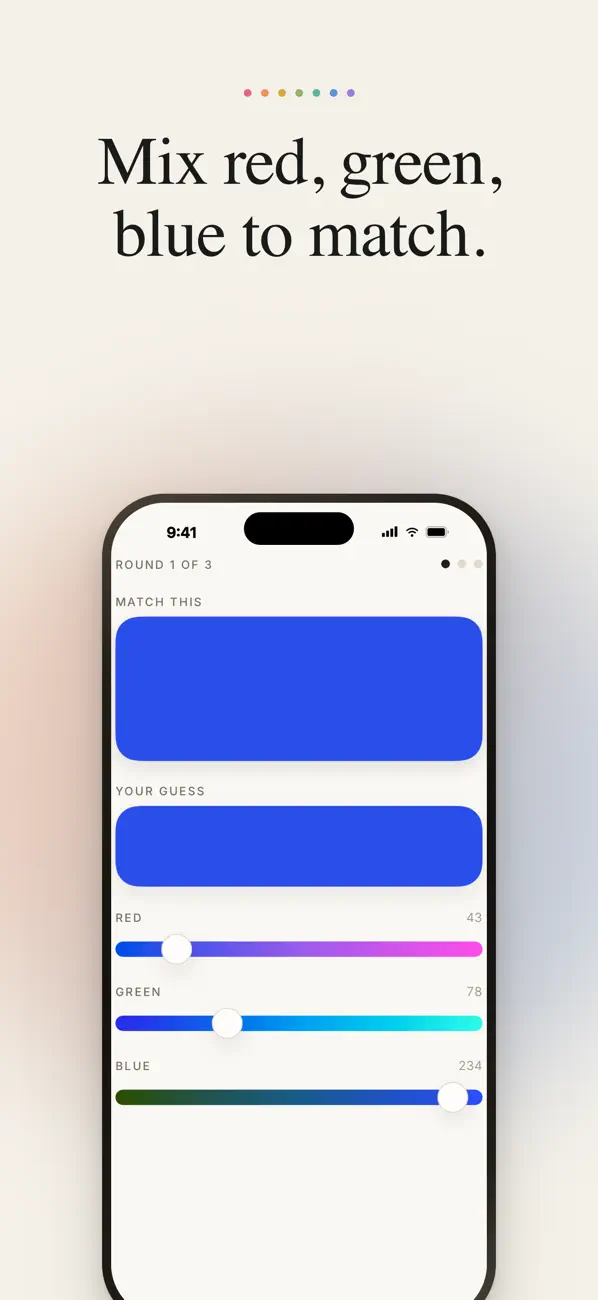
Hueful gives you one new color to match every day, played in three quick rounds:
- Round one: RGB. Match a single color by moving red, green, and blue sliders. It sounds simple until you realize how much green hides inside a warm gray.
- Round two: HSL. A subtler shade, the browns, sages, and mauves, matched with hue, saturation, and lightness. This is where your eye really gets stretched.
- Round three: the gradient. A two-color gradient with both ends to match. Twice the mixing, twice the payoff.
Each round is scored out of 100, so a perfect day is 300. The whole ritual takes about a minute.
- Open Hueful and tap today's puzzle.
- Study the target color for a few seconds before touching anything.
- Set the slider you are most confident about first, then refine the others.
- Lock in your match and read your ΔE score.
What does the ΔE score mean?
ΔE (delta E) is the standard way color scientists measure the difference between two colors as human eyes perceive it, computed in the CIE Lab color space. A ΔE near 0 means the colors are essentially identical. Around 2 to 3, most people can just barely spot the difference side by side. Hueful converts your ΔE into a score out of 100, so improvement is easy to track: if your daily scores drift up over a month, your eye is genuinely sharpening.
Tips to score higher
- Judge lightness first. Squint at the target. Squinting suppresses hue and reveals how light or dark a color really is.
- Name the undertone. Before moving a slider, decide: is this leaning warm or cool? A wrong undertone costs more points than a wrong brightness.
- Make big moves, then small ones. Sweep the slider past the target and walk it back. Creeping up on a color slowly tires your eye.
- Rest your eyes between rounds. Ten seconds of looking away resets your color adaptation and makes the next read more accurate.
Frequently asked questions
Is Hueful free to play?
How long does a daily puzzle take?
Try today's color.
Hueful is free: three quick rounds a day, about a minute total. iOS and Android.