How sharp is your color eye? Take the daily test
Most people never find out how precise their color vision actually is. A color eye test measures it, and a daily one shows you whether it is improving.
A color eye test measures how finely you can distinguish or reproduce colors, usually called hue discrimination. It is different from a color blindness test, which screens for missing or shifted cone sensitivity. Hueful works as a daily color eye test: match the day's color by eye and get a precise ΔE accuracy score out of 100 you can track over time.
What does a color eye test measure?
When people say someone has a good eye for color, they mean hue discrimination: the ability to tell tiny differences in hue, saturation, and lightness apart. Classic tests like the Farnsworth-Munsell 100 Hue Test measure it by having you arrange dozens of caps into a smooth gradient. Your error pattern reveals how fine your discrimination is across the spectrum. Designers, colorists, and printers have used tests like these for decades.
Color eye test vs. color blindness test
They answer different questions. A color blindness test (like the Ishihara plates with hidden numbers) screens for color vision deficiency, where certain cone cells respond abnormally. A color eye test assumes you see the full spectrum and asks how precisely you can use it. You can pass an Ishihara test easily and still struggle to tell two sage greens apart, and vice versa.
One honest note: Hueful is a game and a training tool, not a medical device. If you suspect a color vision deficiency, see an optometrist for a proper clinical test.
How to test your color eye daily
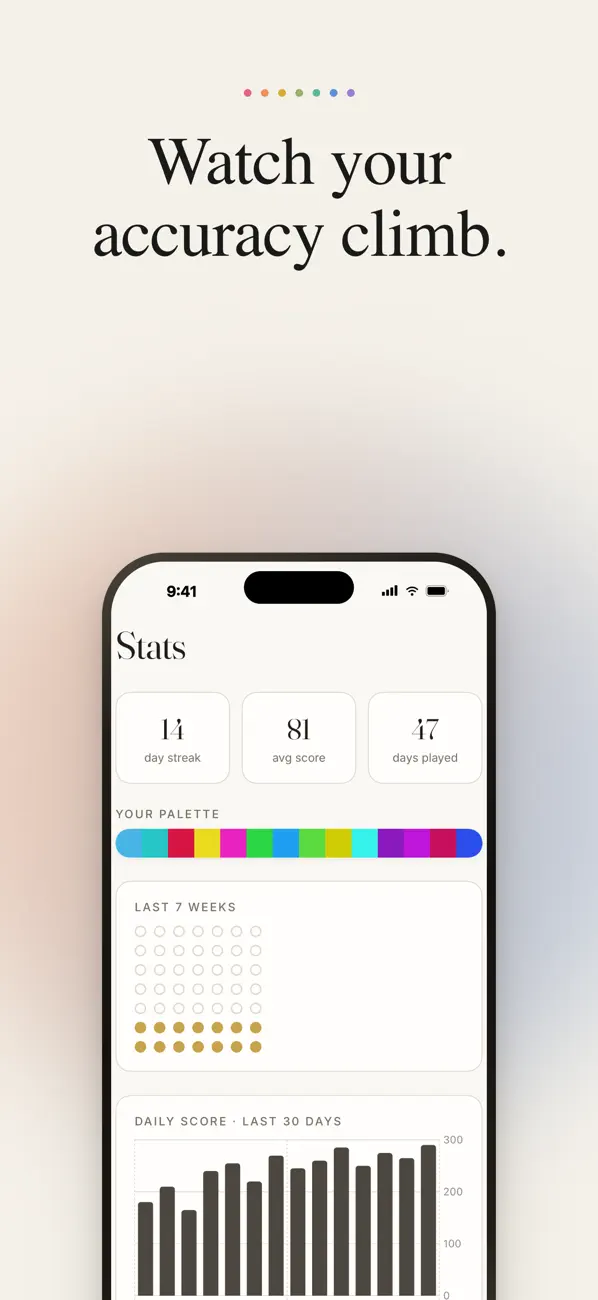
A single test tells you where you are today. A daily test tells you where you are heading, and that is where Hueful comes in. Every day you get one new color and three rounds to match it by eye. Because scoring uses ΔE, the standard perceptual color-difference measure, your score out of 100 is a real accuracy reading, comparable day to day.
- Play the daily puzzle: one color, matched three ways.
- Read your ΔE score for each round. Under 3 is sharp; under 1.5 is exceptional.
- Check your history after two weeks. A rising average means your discrimination is genuinely improving.
- Compare with the Game Center leaderboard if you like a benchmark.
What is a good score?
On Hueful's 100-point scale, most new players land in the 70s and 80s: they get the hue family right but miss the saturation or lightness. Scores in the 90s mean your match is within a few ΔE of the target, a difference most people could not spot across the room. Consistent high-90s across the RGB, HSL, and gradient rounds puts you in genuinely trained-eye territory.
Frequently asked questions
Is Hueful a color blindness test?
Can I test my color eye more than once a day?
Try today's color.
Hueful is free: three quick rounds a day, about a minute total. iOS and Android.