How to improve your color perception, a minute a day
Your cones are fixed at birth. What your brain does with their signal is not. Color discrimination is a skill, and skills respond to practice.
You cannot change the biology of your eye, but you can train your brain's ability to discriminate colors. Perceptual skills sharpen with repeated, feedback-driven practice. A daily session in Hueful gives exactly that: match a new color by eye each day and watch your ΔE accuracy scores improve over weeks.
Can color perception actually improve?
Yes, within honest limits. The number and type of cone cells in your retina are set, which is why true color blindness cannot be trained away. But discrimination, the ability to tell close colors apart and judge their components, happens in the brain, and it behaves like other perceptual skills. Wine tasters, fabric dyers, paint mixers, and print colorists all develop measurably finer discrimination in their domain through years of feedback. The research field is called perceptual learning, and its core finding is simple: precision improves when practice comes with immediate, accurate feedback.
The three ingredients of effective training
- Active production, not passive viewing. Mixing a color yourself engages the judgment you are trying to train. Scrolling past pretty palettes does not.
- Immediate measured feedback. You need to know not just that you missed, but by how much and in which direction. This is what a ΔE score gives you.
- Spaced repetition. A minute every day beats an hour once a month. Perceptual gains consolidate between sessions.
A training plan that fits in a coffee break
- Daily, weeks 1-2: play the daily puzzle and just notice your scores. Most players discover one weak dimension, usually saturation.
- Weeks 3-4: before each round, predict your score. Calibration is itself a perceptual skill.
- Ongoing: watch your average in the stats history. Plateaus are normal; they usually break after a few days.
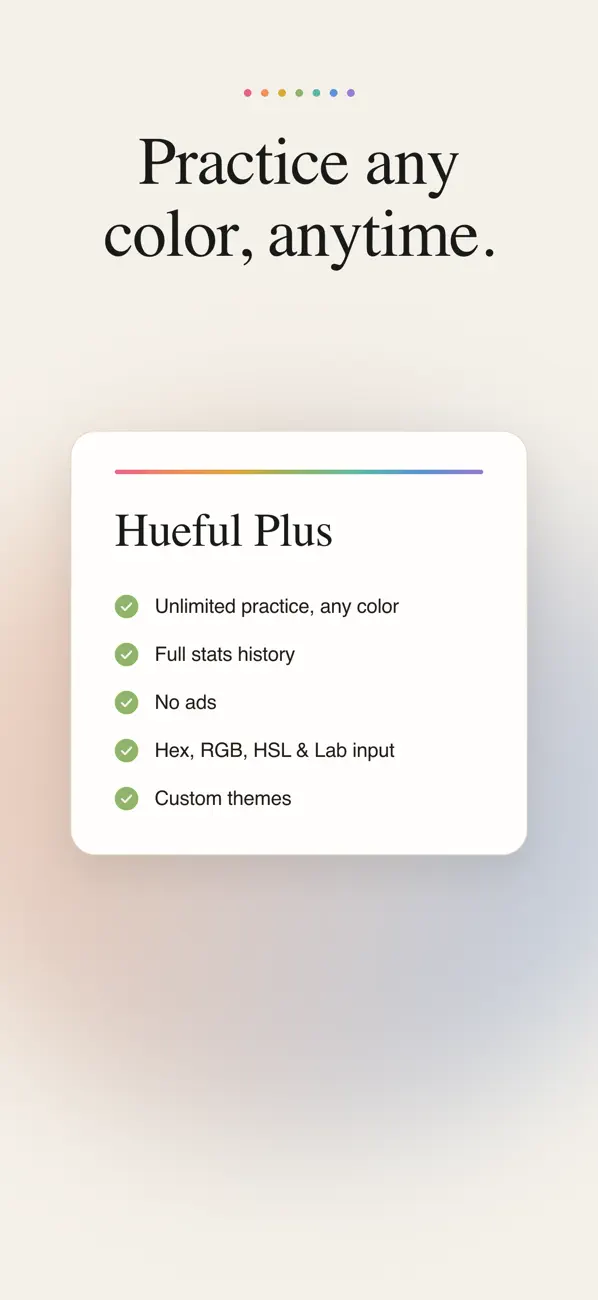
- Optional: add Hueful Plus practice sessions on your weak spots, like low-saturation earth tones, the hardest colors to read.
How you'll know it's working
The scores make progress visible: a rising daily average means your matches are landing at smaller ΔE distances, which is the definition of finer discrimination. Off-screen, the changes are more fun. Players report noticing undertones in paint chips, catching when a photo's white balance is slightly green, and winning arguments about whether the couch is gray or greige. Your palette history in Hueful becomes the record: months of colors, matched more and more tightly.
Frequently asked questions
Can training fix color blindness?
How long until I notice improvement?
Try today's color.
Hueful is free: three quick rounds a day, about a minute total. iOS and Android.