Color theory practice that takes a minute, not a semester
You can memorize the color wheel in an afternoon. Actually seeing what saturation does to a mauve takes reps. Here is how to get them.
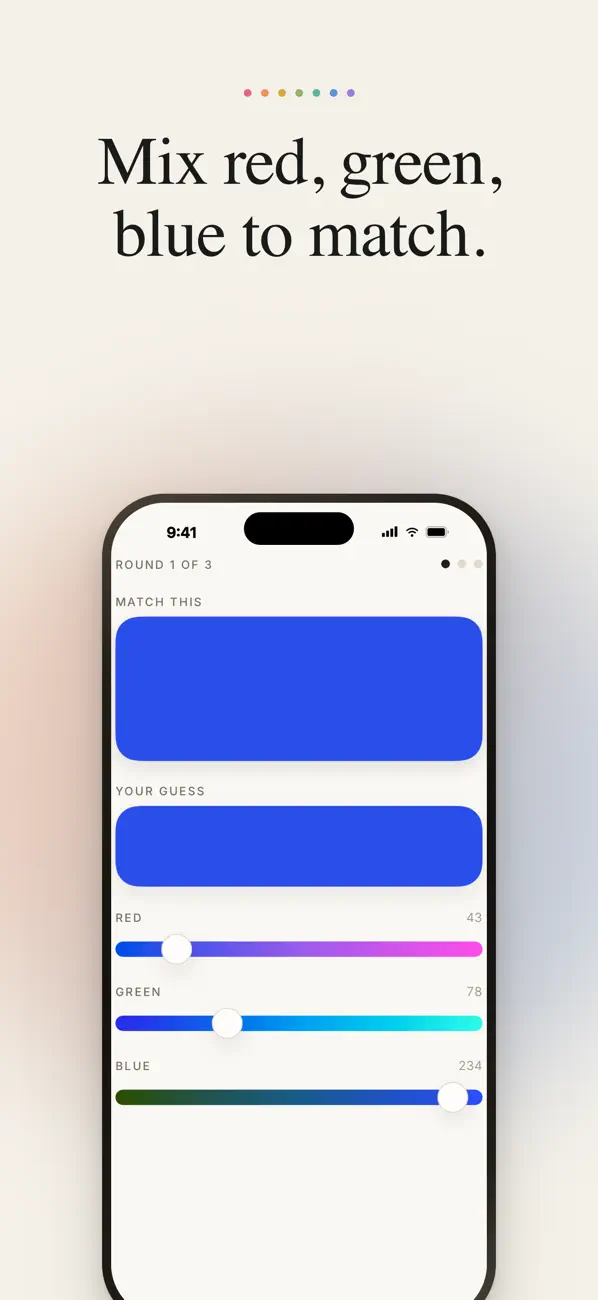
The fastest way to practice color theory is to actively mix colors and get scored on accuracy. Hueful gives you that rep daily: read a target color, rebuild it with RGB sliders, then a harder shade with hue, saturation, and lightness. The ΔE score tells you exactly which dimension your eye misjudged.
Why color theory only sticks when you practice it
Color theory books explain relationships: complements, temperature, value contrast. But the working skill behind all of them is the same, the ability to look at a color and read its ingredients. Is that gray warm or cool? Is that red darker than that blue? Painters learn this by mixing paint badly a thousand times. You can learn it faster with instant, measured feedback.
The three reads every colorist develops
- Hue: which family the color belongs to, and how far it leans toward its neighbors. Most sage greens are yellower than beginners think.
- Saturation: how much gray is hiding in the color. Real-world colors are far more muted than the colors people mix from memory.
- Lightness: the value read, the one your eye is worst at when hue is loud. Squinting helps because it strips hue away.
A one-minute daily practice routine
- Round one (RGB): before touching the sliders, say your prediction out loud: "mostly red, some green, almost no blue." Then check yourself.
- Round two (HSL): this is the color theory rep. Read the hue first, then guess the saturation as a percentage, then set lightness with squinted eyes.
- Round three (gradient): notice how the two endpoint colors relate. Complements? Analogous? Naming the relationship is the theory part.
- Read your ΔE result per round and note which dimension missed. That is tomorrow's focus.
Who this kind of practice helps
Designers picking UI palettes stop nudging hex codes at random and start moving straight toward the color in their head. Illustrators and painters mix cleaner because they can name an undertone before committing. Photographers grade skin tones with more confidence. And students of color theory finally connect the vocabulary to something their eye can verify.
Going past the daily
When one rep a day stops being enough, Hueful Plus opens unlimited practice at any difficulty, plus advanced input modes: type hex, RGB, HSL, or Lab values directly and learn how the number systems map onto what you see. Working in Lab especially builds intuition for lightness as its own dimension, which is the heart of value control.
Frequently asked questions
Do I need to know color theory before playing Hueful?
Does Hueful support hex and Lab input?
Try today's color.
Hueful is free: three quick rounds a day, about a minute total. iOS and Android.